Showing posts with label salad. Show all posts

Sunday, February 24, 2008

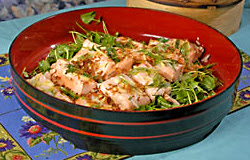
Armenian Parsley & Walnut Salad


When entertaining last weekend, we did a mixed grill: racks of lamb (3), Sicilian-Italian sausage with cheese in it (about 2 pounds), and some marinated chicken breasts too. We had grilled provolone cheese (I'll post the recipe soon) and some wonderful coriander lime shrimp as appetizers, so wanted a fairly simple side to serve with the meat. This salad came to mind as it's just wonderful with grilled meats, and it has a kind of Italian bent with the Mediterranean olives mixed in.


The recipe came from Nicole Aloni, a Hollywood caterer and cookbook author. She taught a cooking class some years ago, and we all enjoyed the food, but her stories about entertaining the celebs in Hollywood was most interesting. She kind of became a caterer to the stars by default - lucky, I guess - but her food is very good. Nothing healthy about it, usually, although this salad isn't a bad choice. She particularly works at preparing food the day before a party.


The salad is mostly composed of parsley (the curly leafed, not Italian) and toasted walnuts. But it's accented with Kalamata olives, green onions and fresh tomatoes, then tossed with a cumin, lemony dressing. Oh, and a bit of red chile flakes.


Cook's Notes: You could easily change the proportions of these items to suit your tastes, but the parsley needs to be the featured green. Ideally, make this one day ahead, but any longer than that and the parsley wilts down to nothing. Once you've made the salad, taste it and decide if you'd like to add more tomatoes, or parsley. Or perhaps more olives. Chop the olives fairly small, as they can overpower your taste buds if you get much of it in one bite. And don't skip the walnut toasting step - they add a wonderful grace note to the flavor in the overall salad.

Armenian Parsley & Walnut Salad
Recipe By : Nicole Aloni, author and caterer
Serving Size : 8
1 cup walnuts -- chopped, toasted, or almonds
2 bunches parsley -- regular curly, coarsely chopped
3/4 cup kalamata olives -- pitted, minced
1/2 cup scallion -- minced
1 cup fresh tomatoes -- peeled, seeded, chopped
1/3 cup extra virgin olive oil
1/3 cup fresh lemon juice
1/2 teaspoon cumin powder
1/2 teaspoon red pepper flakes
Kosher salt and pepper to taste
1. Toast nuts at 325° for about 10 minutes. Cool completely before using in the recipe.
2. Remove stems from the parsley and coarsely chop. Do not use a food processor for this as they will be too fine.
3. Chop the olives, walnuts and green onions, then combine all ingredients, tossing with the dressing. Add salt and pepper to taste. Chill.
NOTES : If the tomatoes are out of season, add just a teaspoon of sugar to sweeten them. You can also add mint to this salad if that is a flavor you enjoy. Be sure to use regular curly parsley (not Italian flat leaf) as it gives the salad some "lift." This improves if made a day ahead.
Per Serving: 248 Calories; 24g Fat (82.7% calories from fat); 5g Protein; 7g Carbohydrate; 2g Dietary Fiber; 0mg Cholesterol; 365mg Sodium. Exchanges: 0 Grain(Starch); 1/2 Lean Meat; 1/2 Vegetable; 0 Fruit; 4 1/2 Fat.
Printer-friendly recipe, click title at top.

Saturday, February 2, 2008

Scott's Broccoli Salad


My salivary glands are in overdrive. In the window in which I type my posts, this picture looms large. More than life size. But that little nubbin of walnut sitting there on the side looks so real I could reach through the screen to tuck it in my mouth.

I met my friend Joan W. at the Long Beach Yacht Club the other day. Long Beach is about 30 miles west of where we live. Joan's a member of the Yacht Club, so we occasionally meet there. She and I met in about 1995 at an NAIC (National Association of Investor's Corp.) seminar - we're both in investment clubs, and sat next to one another for the day while we learned all about how to use a specific software package called Toolkit, made for investment clubs, and for individual investors too. We've been friends ever since!

The salad bar and carving station are available every weekday at the Yacht Club, and it was wonderful. Joan told me I needed to try the broccoli salad, that it's a favorite of hers. Sounded good to me. Oh my. Was this ever delicious. It's the honey that is the wild card in this recipe. It's a sweet salad, but somehow broccoli seems to be able to handle some sweet. Fortunately for me - and for you, my dear readers - Joan has the recipe, that was devised by the Yacht Club's chef, Scott, a real winner of a recipe.

Cook's Notes: Understand, please, that I haven't made this, but I think I'd try this without candying the walnuts - it's plenty sweet already. But I don't want to detract a thing from Scott's recipe. It's a stunning one, and if you like the combo with the honey and sweet walnuts, go for it!

Scott's Broccoli Salad
1 bunch broccoli, raw, chopped
1/2 small red onion, julienned
2 T. dried cranberries
1/2 cup candied walnuts
1/2 cup Stilton cheese, or Blue, crumbled
3/4 cup honey mustard dressing (see below)
Combine everything except dressing, then add dressing, just so the vegetables are covered to your satisfaction, and serve.

Honey Mustard Dressing
1 cup honey
1 tablespoon Dijon mustard
1 dash red wine vinegar
Pepper to taste
Combine ingredients and stir to mix thoroughly.
Per Serving (recipe assumes you use all the dressing, which you will not): 207 Calories; trace Fat (1.9% calories from fat); 3g Protein; 53g Carbohydrate; 3g Dietary Fiber; 0mg Cholesterol; 61mg Sodium. Exchanges: 0 Lean Meat; 1 Vegetable; 0 Fruit; 0 Fat; 3 Other Carbohydrates.
Printer-friendly recipe, click title at top.

Thursday, January 24, 2008

Carrot-Ginger Slaw


Do you sometimes forget how good vegetables can taste? I forget about all the variations on vegetables. I need a little memory jog now and then to remind myself that there's more than one way to make cauliflower. Or broccoli. Or zucchini. Or. Or. Or. It could go on and on.

And surely I forget about using carrots - in a raw form, other than eating out of hand. So I was reading Fresh Approach (a blog I read regularly) and Rachael had made this carrot-ginger slaw. Well, my eyes and nose perked up and I immediately printed out the recipe. I had everything on hand except the fresh ginger. But I had some in a bottle, which I'm sure wasn't AS good, but this salad was so refreshing (next time I really will have the fresh ginger). I have Italian parsley in my garden, but I had an abundance of cilantro in my refrigerator, so I used cilantro instead. DH loved it. So did I. And it took a maximum of about 7 minutes to make it. Literally. That part I liked a lot. And it was better than having another - yet another - green salad. Don't get me wrong, I love green salads. Really I do. But there's a tedium about making green salad. And I like homemade dressing too, which adds to the hassle.

When my daughter, Dana, was a little tyke, she first learned how to bake cookies. That's probably universal in this day and age. Children and cookies just go together like peas in a pod. Or puppies and little boys. Once she got a bit older I began teaching her about knife skills. Probably when she turned 8 or so, and I thought she was mature enough to hold and wield a dull knife.

Initially, she was thrilled with her new-found skills and independence. She liked helping in the kitchen, and was very proud of her accomplishments. But the interest began to wane in the years to follow. I was a working mom, had to get dinner on the table in fast order, so setting the table and making a salad was what helped me the most. She wasn't old enough or tall enough really to master a spatula and frying pan at the hot stove, or many other things with hot pots and pans, so the salad making was the best choice. As she got older still she began to dislike making a salad unless it was just chopped lettuce. I like lots of vegetables in my salads. Back then it was mostly carrots, celery, green onions, tomatoes and peppers. Now I add lots of other things like fennel, Feta crumbles, sugar snap peas, nuts, even. But she didn't enjoy the chopping and cutting anymore, probably because it was so repetitive.

Here's the salad maker now, a picture taken when we were at Dana and Todd's house over Christmas - she's 39 now. When I was 39, she was 13, going on 30. But that's another story. Now she makes salads all the time for her family. And mostly they're just lettuce. Her kids don't much like eating raw vegies. They look at salad as merely a vehicle for consuming ranch dressing. But Dana thoroughly enjoys all the homemade dressings. When we talked on the phone the other day she was busily making her favorite of my dressings, the VIP Salad Dressing, which I posted last year. It may have been my very first posting on this-here blog. Or one of the first. And that dressing is still one of my very favorites too.

Last summer Dana's two children were here to visit for awhile, and the 10-year old, Taylor, was anxious to help me in the kitchen, so I taught her how to make salad. How about that. What goes around, comes around. Dana was a bit in shock when I told her I'd taught Taylor how to use a sharp knife. She did just fine, sweetie! Mom knows all. That's a bit of an inside family joke if you didn't get it. Dana reads my blog every day, so am certain I'll be hearing from her about that! Anyway, I just listened to someone on the radio the other day, that most children, when they reach about 7 or 8, are old enough to learn how to use a knife in the kitchen.

So, I've rambled on far too long here. Telling family stories. Suffice that this not-green-salad is a good one, a keeper, but probably not one for children to make unless an adult grates the carrots and ginger. Other than that, children could likely do all the rest. If it's a kid-making deal, maybe start them out with green salad and teach them some knife skills.

Carrot Ginger Slaw
Recipe: Fresh Approach blog
Servings: 6
6 whole carrots -- peeled
1 cup chopped parsley
2 teaspoons vegetable oil
3 tablespoons seasoned rice wine vinegar
1/8 teaspoon ground Szechuan peppercorns
3 tablespoons fresh ginger -- grated - use a Microplane
1/4 cup mayonnaise
1 teaspoon sesame oil Sesame seeds and more parsley for garnish
1. Using the large holes on your box grater (or the shredder disc on a food processor), shred the peeled carrots.
2. Toss that with the parsley.
3. In another bowl, combine the oil, vinegar, Szechuan pepper, ginger (and the juice), mayo and sesame oil. Taste and adjust to your taste.
4.Stir that into the carrots, let rest for a few moments, garnish and serve.
Per Serving: 135 Calories; 10g Fat (64.9% calories from fat); 1g Protein; 11g Carbohydrate; 3g Dietary Fiber; 3mg Cholesterol; 345mg Sodium. Exchanges: 1 1/2 Vegetable; 1 Fat.
Printer-friendly recipe, click title at top.

Monday, December 17, 2007

Watercress, Belgian Endive Salad with Black Olive Vinagrette


I was really prepared to NOT like this salad. I mean, Kalamata olives are strong. Pungent. Overwhelming in flavor sometimes. I certainly don't like eating them straight away. And I thought they'd just overwhelm the tender watercress and Belgian endive leaves. I should know better than to distrust Phillis Carey, one of my favorite cooking teachers. She made this salad at the cooking class I attended in San Diego, at Great News, about 10 days ago.

She made this salad as part of a tenderloin of beef dinner. And it was absolutely delicious. I'll be making this again and again. It would be perfect with nearly any kind of grilled meat. Even fish. It would make a lovely first course too. It's colorful. Delicious.

Phillis soaked the red onion in acidulated water (with the vinegar) for 10-20 minutes. I'd forgotten that technique of getting the pungency, the bitterness, that sharpness out of onions. I might soak them longer, depending on the onion I used. And I found another use for my ball bearing whisk. I forget to use this thing, but it was perfect for the dressing here, so you didn't mash up the olive pieces.

Watercress & Belgian Endive Salad with Black Olive Vinaigrette
Recipe By: Phillis Carey, author, cooking instructor
Servings: 6
VINAIGRETTE:
1/2 cup pitted black olives -- Kalamata, divided use
1 clove garlic -- minced
1/2 teaspoon fresh rosemary -- chopped
3 tablespoons red wine vinegar
5 tablespoons extra virgin olive oil Salt & pepper to taste
SALAD:
1 small red onion -- halved, thinly sliced
2 tablespoons red wine vinegar
3 whole Navel oranges -- skinned, cut in sections
2 bunches watercress -- thick stems discarded
2 whole Belgian Endive -- halved, thinly sliced, cut at last minute
1/2 cup Italian parsley -- chopped
1. Coarsely chop 1/4 cup of the olives and place in a small, separate bowl.
2. Place remaining olives in food processor with the garlic and rosemary, pulse to chop. Add vinegar and pulse to combine. Add this mixture to the separate bowl of olives and using a ball-bearing whisk, combine the mixtures. Season to taste with salt and pepper, then cover and refrigerate up to one day ahead. May also be left at room temperature for up to 2 hours.
3. Salad: place the onion slices in a small bowl and cover with cold water. Stir in the vinegar and allow this to stand for at least 10 minutes (more if you'd like less pungency to the onions). Drain.
4. Using a sharp knife, peel the oranges, removing all the white pith. Cut between the membranes to release the orange sections and place in the salad bowl. Do this job over the bowl to save any of the orange juice. Add the watercress, endive, parsley and drained onion. Toss with dressing and season with salt and pepper if needed. Serve immediately.
Per Serving: 162 Calories; 13g Fat (66.3% calories from fat); 2g Protein; 13g Carbohydrate; 3g Dietary Fiber; 0mg Cholesterol; 109mg Sodium. Exchanges: 0 Grain(Starch); 1/2 Vegetable; 1/2 Fruit; 2 1/2 Fat; 0 Other Carbohydrates.
To print a PDF recipe, click title at top.

Thursday, October 4, 2007

Escarole, Belgian Endive and Apple Salad


It's fall. Time for some fall-type salads. Soups. Stews. Pumpkin. If it would just get below 80 degrees here in southern California I'd feel more like it. Soon. But, because it is October, I'm ready. Therefore, I went through my salad recipe collection looking for something different.

I make just regular green salads all the time. Probably all of you do, too. My mother was a great one for incorporating lots of vegies in salads, so I have continued the tradition. Green salads must have some other stuff like radishes, cucumber, tomatoes, celery, bell peppers, carrots, sugar snaps. That kind of thing. Just a way for us to get more of those healthful vegies in our diet. And when you wrap those in silky salad dressing, they sure do go down easier. And I like vegies. Today's salad, though, isn't one of those. It's a pure greens salad but with an opportunity to give the apple a star billing. And escarole, of course.

So, this salad came from one of the cooking classes I took with Joanne Weir. I think I've mentioned before she's probably my very favorite cooking instructor ever. She's just so witty and funny. And bursting with lots of helpful hints. This class was no exception. Remember my adage: if you come home with one recipe you make regularly, the class is worthwhile and money was well spent. This class provided one good recipe AND a very good helpful hint that I've used over and over.

The hint: when making a salad dressing on the spot, once it's mixed up (using a whisk always) take a piece of the lettuce from your already prepared greens and dip it into the dressing. Use it in proportion - you don't want it saturated with dressing, just a bit. Taste it for balance (oil vs. vinegar) and seasonings (salt and pepper). And know that you need it to be saltier than it should be from that one little bite, because once the dressing is tossed all over the salad, the salt will be dispersed.

So now, onto the actual salad. Escarole isn't a green I normally purchase. It's not as bitter as curly endive (which was what I found at the market yesterday and is shown in the photo), and it's easier to eat than curly endive too. Escarole is actually chicory (the green, and also the root that's added to coffee in the south). It is part of the bitter greens family. Belgian Endive is another one of those vegies I purchase occasionally and is in the same family as escarole/chicory. I've learned though, that the longer I hold Belgian Endive, the more bitter it gets. Ever noticed that? So I try to use it up right away.

Some years ago when my DH and I visited France and stayed with a friend in Paris, she made a Belgian Endive salad, just tossed with a little bit of olive oil and lemon juice. It was sweet and oh-so tasty. I'd had B.E. before, but it never tasted as good as I had it there. Once home I determined I'd use it more. I was so disappointed when I bought half a dozen of them to make a similar salad. It was so bitter we couldn't eat it, even though it was fresh from the grocery store.

In looking up the nutritional information about B.E. I learned that it turns bitter as it oxidizes (exposed to light). So, I guess from the moment it's plucked from the ground it begins to turn bitter. No wonder I have such a problem. A little bit of that bitterness goes a long ways. Probably U.S. growers have developed varieties that can have a long shelf life, but the taste is obviously compromised. I wish some of the growers here could taste B.E. in France to see the significant difference.

So, this salad combines bitter greens with a bit of sweet from the apple. The original dressing didn't have any sugar in it, but I find that the dressing is also quite tart, so the addition of just a little bit of sugar helps it a lot. But I've also learned from making this salad several times that the acidity of sherry wine vinegar can vary from brand to brand. So I also have to add, sometimes, a bit more oil to the dressing than it calls for. That's another reason for using the dunk-the-leaf-in-the-dressing technique. I do that once before I add salt and pepper and again after to make sure it's the right chemistry.

This salad may not appeal to everyone. You need to like that spark of bitter. If you want more sweetness, though, try using a sweeter apple, and add a bit more sugar to the dressing. Granny Smith's are certainly on the tart side themselves! But, this is a great way to showcase some wonderful fall apples that are just coming into the markets here. And maybe you'll be lucky to find some escarole too.

Escarole, Apple, Almonds and Shaved Parmigiano Salad
Recipe: adapted from a Joanne Weir recipe
Serving Size : 6
1 head escarole -- in 1 1/2 inch pieces
2 whole Belgian Endive -- leaves separated
2 stalks celery -- sliced thin on the diagonal
1 1/2 tablespoons sherry vinegar -- or white wine vinegar
4 tablespoons extra virgin olive oil
salt and pepper to taste
1/4 teaspoon sugar
1 whole Granny Smith apple -- halves, cored, thinly sliced
1/2 cup almonds -- toasted
1/3 cup Parmesano-Reggiano Cheese -- shaved
1. In a bowl toss together the escarole, endive and celery. Place in the refrigerator until close to serving time.
2. In a small bowl whisk together the vinegar, sugar and olive oil. Season to taste with salt and pepper. Will probably need extra salt as once you add it to the greens, you'll lose the saltiness altogether.
3. Dip one leaf of escarole into the whisked dressing to taste for salt and pepper. Toss the greens, vinaigrette, almonds and Parmigiano Reggiano. Add apple slices and toss again. Place one or two apple slices on the top decoratively. Serve immediately.
Serving Ideas : Instead of a traditional salad bowl, serve this on a large platter.
NOTES : Do not use the outer dark green parts of the escarole.
Per Serving (excluding unknown items): 170 Calories; 15g Fat (78.6% calories from fat); 3g Protein; 7g Carbohydrate; 2g Dietary Fiber; 0mg Cholesterol; 17mg Sodium. Exchanges: 0 Grain(Starch); 1/2 Lean Meat; 0 Vegetable; 0 Fruit; 3 Fat; 0 Other Carbohydrates.
To print the recipe only, click title at top.

Wednesday, September 5, 2007

BLT Salad


Well, the good news is that I was able to stand up at the kitchen counter long enough to make one of our favorite summertime salads yesterday. So, my broken bone is still healing well. I'm glad, because I've truly missed cooking. Albeit, I only stood up for about 10 minutes, but that's longer than I've been able to do previously!

So, what is it about bacon that is so darned good? It's that crispy porky piggy flavor, naturally! As with most people, especially those of us trying to watch calories and fat, bacon became a treat, a once-in-awhile kind of treat at least 20 years ago. But I miss it. However, I've found that a little bit goes a long way. Of course, we know that, right? But when a recipe calls for 3 strips, I use 1. I've used turkey bacon and it's okay. I probably should use it always, but I'd rather have less of the real thing and get more of the real flavor. But, what do you do with a big package of bacon when you only need 1 slice? Here's one of Carolyn's tips coming your way. Once I open a package of bacon, I remove the slices I'm using for that meal, then the remaining ones are separated and rolled up, placed on a metal tray - raw - frozen, then the rolls are popped into a Ziploc bag and stored in the freezer. Then, when I need one slice, it's easy to pull out just one. Here's a photo of the bacon rolls currently residing in my freezer.


The photo looks blurry, but it's the vapor in the Ziploc bag you're viewing. Because bacon is mostly fat, it defrosts in a jiffy. And with these little bacon rolls if I really only want a half a slice, a sharp chef's knife will easily cut that one roll in half. If you cut it lengthwise, it's already cut into pieces. But you can chop it a bit more, easily enough.


I do want to talk a bit about bacon itself. I used to buy grocery store bacon. And for some, it may be all that you can afford. I understand - I've been there too. But I've never liked all the tinkering our food manufacturers do with our foods, so I try to avoid chemicals whenever it's feasible. Now that trichinosis is a thing of the past, we needn't worry about acquiring the disease from uncooked pork. So we don't need the nitrates and nitrites so commonly part of the curing process in bacon and other pork products. I avoid them whenever possible. And it's easy to do so if you have a source for Niman Ranch bacon. It's smoked, but uncured. Our Trader Joe's carries it nearly all the time. It's without preservatives, and has a gorgeous taste. It's thick-sliced too, which I prefer. There's a photo of the bacon above - it is a smaller package - 12 ounces I think, rather than a pound. That's to make it a bit more affordable, I'm certain. But I use so little of it, a package will last me months and months once it's in my cute little frozen rolls.

So now, the salad. The recipe for this was published in our local newspaper, The Orange County Register, in 1994. I clipped that little gem out and made it with some home grown tomatoes we had from our garden. It was absolutely fantastic, and I've been making it regularly ever since. I added the basil and the croutons to the original recipe. You can eliminate the croutons if you're watching carbs, but I enjoy the crunchiness of just a few of them. Add as much or as little of the bacon as you see fit. The recipe calls for more than I use, and we're content with it. Certainly you need good, flavorful tomatoes. But even in the dead of winter Trader Joe's and Costco both carry a variety of on-the-vine type that are quite good. So you can really have this year around.

I searched around on the internet today to just see what kind of recipes are out there for BLT Salad. What's unique about this one is the use of rice wine vinegar. It adds a lovely sparkle to the dressing. You can use low-fat or fat free mayo if you want, and it doesn't really make any difference in the taste. Normally I would say nothing but Best Foods (Hellman's) will do, but since the mayo is diluted, there's no appreciable change in the taste. What a great summertime treat. It was delicious for lunch.

BLT Salad (Bacon, Lettuce & Tomato Salad)
Recipe: adapted from the Orange County Register, 1994
Servings: 4
1/2 cup mayonnaise -- fat-free or low fat are fine
1/4 cup seasoned rice vinegar
1/2 head iceberg lettuce -- or mix Romaine and iceberg
4 whole tomatoes -- fresh only
1/2 pound bacon -- meaty slices only
1 1/2 cups bread cubes
2 tbsp fresh basil -- minced
1. Allow bread cubes to stale slightly at room temperature, or you may toast them in the oven briefly. You don't want to have real soft bread, as it will absorb too much dressing and get soggy.
2. In small pan sauté bacon until thoroughly brown and crisp; drain on paper towels and set aside. Break bacon into small pieces when cool. It is best to do this just before serving as bacon won't stay crisp more than about 30 minutes.
3. In a small bowl combine mayonnaise and rice vinegar and stir (or shake in a small bottle) until thoroughly combined.
4. In a large salad bowl chop lettuce, add chopped tomatoes, basil and bread cubes. Add dressing, toss, arrange on serving plates and sprinkle bacon pieces on top.
NOTES : This salad is deceptively easy and delicious. I use half the bacon, but then I always use thick-sliced and it's very meaty bacon. Tomatoes need to be very ripe, so this is a salad I prepare mostly in the summertime. The basil and bread cubes are an addition I've made over the years.
Per Serving: 605 Calories; 52g Fat (76.0% calories from fat); 21g Protein; 16g Carbohydrate; 3g Dietary Fiber; 58mg Cholesterol; 1176mg Sodium. Exchanges: 1/2 Grain(Starch); 2 1/2 Lean Meat; 1 1/2 Vegetable; 6 Fat; 0 Other Carbohydrates. To view a printable recipe, click on the title at top.

Tuesday, July 31, 2007

Hate Brussels Sprouts? Think again!


My mother was a fairly simple cook. She was raised on a farm, as was my dad, in the central valley of California. During the depression. As they grew up, mostly they ate meatless meals with an occasional chicken dinner on Sundays, at noontime, from one of the young roosters in the chicken pen. So when I was growing up my mother followed her mother's tradition - we had simple meals too - a small portion of meat (mostly beef), a vegetable, a salad maybe, and some kind of carb (Minute Rice was a new product - my mother thought it was marvelous, so we had it often).

My recollection of brussels sprouts from my youth is not a particularly good one. Overcooked baby cabbages don't ring any culinary bells for me. And that's most often how my mother cooked them. They were freshly cooked. But with nothing to embellish them except some salt and pepper, they had nothing to make them appetizing. My dad and mom both loved them, though. Fixed just that way. Often. Blah. Yuck.


But I did and do like cabbage in many guises. I just didn't think I liked brussels sprouts. So many years later I decided to buy some fresh brussels sprouts - sold on the stalk - and found a recipe in Sunset Magazine. It may have been the recipe that inspired me to try it again. Lo and behold? I liked them. And I do prepare them in the fall and winter months, steamed, still with some bite to them, with a little butter, salt and pepper. Very good. I must admit.

Our kids didn't think they liked brussels sprouts either, until I made this version below. The recipe takes the lowly sprout to a higher level. You steam or boil them until barely done, then toss with a dressing and let them marinate for a few hours. It's the tart, piquant bacon dressing that makes them taste so darned good. I believe what I've printed below is the recipe from Sunset from years ago. I don't add but a couple of slices (not 6) of bacon to this, and they are still very good. This makes a great side dish - it could qualify as a salad, I suppose. One of the good things about this is you can make it the day ahead too. They're good hot or cold, but I prefer them cold or room temperature. Maybe this will motivate you to try it too.

Marinated Brussels Sprouts
Recipe: Adapted from an old recipe in Sunset Magazine
Serving Size : 6
1 1/2 pounds Brussels sprouts
1/3 cup vegetable oil -- or olive oil
3 tablespoons white wine vinegar -- or lemon juice
2 tablespoons green onions -- thinly sliced
6 slices bacon -- fried crisp, crumbled
1/4 cup red bell pepper -- minced
salt and pepper
1. Trim stems and tear away discolored or torn leaves from brussels sprouts. Cut a small X into the stem of the sprout - about 1/4 inch or less deep. Bring a large quantity of water to a boil and add sprouts, return to a boil and simmer, uncovered, for about 7 minutes until just tender when pierced with a sharp knife or fork.
2. Drain well and place into bowl. Add oil and vinegar, then add onion, bacon, red pepper, salt and pepper to taste. May be served hot, if desired. Otherwise, place in covered container and refrigerate for several hours, stirring a couple of times so all of the sprouts are tossed with the dressing.
NOTES : This is best if allowed to marinate for a few hours or overnight. This is something that can be made ahead and keeps well for several days.
Per Serving: 191 Calories; 16g Fat (69.1% calories from fat); 5g Protein; 10g Carbohydrate; 4g Dietary Fiber; 5mg Cholesterol; 127mg Sodium. Exchanges: 1/2 Lean Meat; 2 Vegetable; 3 Fat; 0 Other Carbohydrates.
To view a printable recipe, click on title at top. (photos from foodtv.ca and greengiantfresh.com)

Friday, July 27, 2007

Grilled Salmon with Watercress Salad


(Photo from livegourmet.com, a company that produces watercress.)
If I owned a restaurant, this would probably be my signature dish. I'm sorry I don't have a photo of the really pretty platter of food it makes with all the grilled vegetables around the outside. This photo above looks a lot like my grilled salmon with watercress. I've made this so often that I might be able to make it in my sleep. And it is my one-and-only recipe for which I can buy the ingredients in the late afternoon and have dinner on the table by 6:30 or 7:00 - for guests. This is a one dish meal - well, clarify that . . . it's a grill in one meal. Except for dessert and appetizers, if you're serving them, you can make this in no time at all. It may be the only recipe in my entire personal cookbook that qualifies. So, take note, if you'd like a company meal with little effort.

My friend Stacey is a good cook, but doesn't really like spending hours in prep, nor does she have time anymore with two little ones getting into mischief. But after I made this at their house in the Bay Area one weekend several years ago, she said they invited lots of friends over and she got a lot of entertaining done - serving this for every one. So, Stacey, this one's dedicated to you! You're my hero!

I've told you before about Chris Schlesinger. His book, The Thrill of the Grill, is one of my favorite cookbooks. This recipe came from there. This is the fellow I spoke to, telling him my favorite recipe from his book was the Asian Slaw and he gave me this face. If you haven't read that story, click here. When he signed my cookbook, I hadn't prepared this salmon dish yet. I just wish Chris was reading my blog and he'd know that this is my favorite recipe to date. And I've amplified on his recipe too. I've thought about writing to him tell tell him all about what I've done to his recipe. But oh well. He's a famous chef and all. I think I won't.

For awhile, some years ago, I cut down the amount of the dressing on this salad, to reduce the total fat grams, but have since decided that the full amount is needed; it's an important component of the dish so it covers the salad sufficiently and you have enough left over to pour a little over the salmon itself. And if you grill vegetables to go with, like I do, then you need a bit more for them too. Salmon has plenty of fat in its tissues, but it's good fat, so don't be thrown by the fat content on this one. I've done the math and the salad dressing is fairly inconsequential.

I do need to talk a bit about watercress. It's a little hard to find - at least it is here in California. Whole Foods sells some funny kind of young watercress still growing in vermiculite covered in a little root ball. It has different roundish leaves. And has almost no flavor. This is NOT what you want for this. You need the real thing, the kind of watercress that's actually grown in water (that's why it's called watercress, silly!). It has fattish stems (which you don't use in the salad) and wonderful crinkly leaves. The taste is peppery, not to everyone's taste, I suppose. I love it, though. So seek out good, fresh watercress.

Costco sells this huge slab of boneless salmon. It is farm-raised; not my favorite thing anymore, but I will buy it on occasion. I prefer wild caught now, and if you can find it, by all means do so! You wipe it off, spray it with olive oil spray, then place it on two large pieces of greased heavy-duty aluminum foil, crimp up the edges around the salmon (you don't seal it or cover it). Add a bit of salt and pepper. Meanwhile, you fire up your grill and start working on the vegetables, whichever ones you decide to use. I like putting something red with this dish - the color is just glorious on a large platter. So, you need red bell peppers for sure, even yellow or orange ones too. Asparagus works also. And zucchini too. In a pinch I've also thrown a large quantity of halved cherry tomatoes on the platter at the end (not grilled, of course). And DH's favorite is small red onions, halved. All the vegies need to be well oiled, then grilled. Then you put on the salmon and it's done when you begin to see some white foam seep up through the middle of the salmon. At the last minute toss the watercress salad with some of the dressing, spread it down the middle of the large platter, then slide the salmon off the foil and on top of the salad and add the grilled vegies (that you've kept hot) around the edges. Serve immediately to raves. Guaranteed.

Grilled Salmon with Watercress Salad
Recipe: adapted from "The Thrill of the Grill" cookbook
Servings: 6
2 1/2 lb salmon fillet -- max 1" thick
DRESSING:
2 bunches watercress
1/2 medium red onion -- thinly sliced
2 tablespoons sesame oil
1 teaspoon sugar
2 tablespoons soy sauce
1 tablespoon fresh ginger root -- minced
2 tablespoons rice wine vinegar
2 tablespoons red wine vinegar
4 tablespoons olive oil salt and pepper -- to taste
2 tbsp sesame seeds -- toast in teflon pan
VEGIES (optional):
3 whole red onions -- peeled, halved or quartered
2 pounds asparagus
4 whole red bell pepper -- quartered
1. Heat a non-stick pan and toast the sesame seeds, stirring occasionally, until golden brown. They tend to burn quickly, so stir often when they start to brown.
Salad: wash well the bunches of watercress and pull the small stems off and discard the large stems. Dry in a towel. Place watercress and red onion in a plastic bag and keep until ready to serve.
2. Vinaigrette: combine the oil, sugar, soy sauce, ginger, vinegars, olive oil and salt and pepper to taste. It is best if this is allowed to sit for a few hours, refrigerated, before dressing the salad.
3. If using vegetables, prepare them, oil them, then grill to your taste, being careful not to burn. Move to the side before they're completely done and add the salmon.
4. Fish: Spray the top of the salmon with olive oil spray. Using either heavy-duty foil, or two layers of regular foil, spray the foil with olive oil spray, then place fillet on foil and curl up edges to make a sort of a "pan." Place on grill for 12-20 minutes, or until the inner juices of the salmon have begun to bubble up in the meat (whitish fluid).
5. Immediately before serving, in a large bowl combine the watercress and onion and add most of the vinaigrette to taste - really, taste it to make sure it's right. Sometimes I add green and/or red leaf lettuce to the salad mixture as well. Pour the salad out onto a large platter and place the hot, grilled fish on top. Pour the remaining vinaigrette over the top of the salmon and sprinkle with the toasted sesame seeds and serve. It says this is excellent served cold although we've never done it that way.
6. NOTE: This is also excellent made with halibut or swordfish. The salmon is the best, however. Serving Ideas : Good for a hot, summer night. I've served this with asparagus, simply dressed with seasoned rice wine vinegar sprinkled over the spears, or green beans. Sometimes I also decorate the platter with halved cherry tomatoes, to give it some color. Or, more often, we grill red and yellow peppers (sprayed lightly with olive oil spray) and place them around the outside of the platter. If you do the peppers, grill them before you put on the salmon, then push them off to the side when you put the salmon on. We also like to add red onions (quartered, sprayed with olive oil) to the platter - they should go on the grill first, as they can take 30 or more minutes. NOTES : This is really a fairly simple dish. Everything can be done ahead except grilling the fish.
Per Serving: 441 Calories; 22g Fat (44.4% calories from fat); 42g Protein; 20g Carbohydrate; 6g Dietary Fiber; 98mg Cholesterol; 481mg Sodium. Exchanges: 0 Grain(Starch); 5 1/2 Lean Meat; 3 Vegetable; 3 Fat; 0 Other Carbohydrates.
To view a printable recipe, click on title at top.

Saturday, June 30, 2007

Sweet Potato Salad


I'm always looking for different ways to serve vegetables or sides for warm, summer barbecue dinners. I must have been watching Bobby Flay last summer when he prepared this. I made it right away and liked it a LOT. It's not difficult to prepare, although you do have to bake (or cook somehow) the sweet potatoes, then you pare them, slice and grill them, along with the green onions, then make the dressing and toss it together. It can be served hot, room temp or chilled, and it keeps for about a week.

Grilled Sweet Potato and Scallion Salad
Recipe By: Bobby Flay of the Food Network
Servings: 8

4 large sweet potatoes
8 whole scallions
3/4 cup olive oil -- divided use (1/4 cup for grilling, balance for dressing)
2 tablespoons Dijon mustard
1/2 cup cider vinegar
1/4 cup balsamic vinegar
2 teaspoons honey
Salt and freshly ground pepper
1/4 cup Italian parsley -- coarsely chopped

1. Bake potatoes in a 350 oven for about 40-50 minutes until JUST barely done. Remove and allow to cool, then peel and cut into 1/2 inch lengthwise slices.
2. Preheat grill to high. Brush potatoes and scallions with 1/4 cup oil and arrange on grill. Grill potatoes for 3 to 4 minutes on each side, or until just tender. Grill scallions until softened and marked. Remove scallions from the grill and cut into thin slices.
3. In a large bowl, whisk together 1/2 cup olive oil, the mustard, vinegars, and honey. Season with salt and pepper, to taste. Add potatoes, scallions, and parsley and toss until potatoes are well coated. Transfer to a platter and serve.
Per Serving: 264 Calories; 21g Fat (68.2% calories from fat); 2g Protein; 20g Carbohydrate; 3g Dietary Fiber; 0mg Cholesterol; 59mg Sodium. Exchanges: 1 Grain(Starch); 0 Lean Meat; 0 Vegetable; 0 Fruit; 4 Fat; 0 Other Carbohydrates.
To view a printable file click on the title at the top.

Monday, June 18, 2007

Ina's Pesto Pea (Spinach) Salad


Sorry about the blurred photo. I enhanced it as much as possible in my photo program, but this is as good as it gets. We had the family for dinner to celebrate Father's Day, and I quickly snapped this and didn't check it before shutting off the camera. When you do a close-up with a digital camera, it's harder to keep perfectly still, so I try to be very conscious of that when I finally click the shutter.

But, that doesn't mean the salad isn't wonderful. I saw Ina Garten demonstrate this on her food network program, probably 2 years ago. It's from her book, Barefoot Contessa at Home. Maybe the peas and spinach seem like an unlikely combination, but it sure works. Over the years I've used pesto in pasta dishes, of course, and to dollop on the top of certain soups, and as a dip, but never would have considered it as a salad dressing. I had some homemade pesto in the refrigerator, so this was a simple dish to throw together. Trader Joe's carries a baby spinach, which is preferable here. Regular spinach is just too big for a salad - the pieces are too large without cutting them. I suppose you could do that, but the baby spinach just makes it so simple. I do tear off some of the larger stems, but most of them stay in the salad.

I find this salad goes so very well with a grilled dinner - chicken, steaks, pork chops, even fish. I hate to sound redundant, but this salad is SO simple. You just have to toast the pine nuts (I use a nonstick frying pan) and I caution you if you haven't done this before - watch the pan very very carefully or they will burn. Pine nuts contain a high percentage of oil, so they burn very rapidly. I keep pine nuts in the freezer at all times, so just remove what you need for a meal.

And, the other thing I do is add more Parmesan cheese (that's my addition to Ina's recipe). Often, I believe, when you buy ready-made pesto, it doesn't contain as much cheese as your own homemade variety, so I add some to the salad itself. It adds some color contrast too.

Pesto Pea (Spinach) Salad
Recipe: Barefoot Contessa at Home by Ina Garten
Servings : 4

2 cups frozen peas -- baby peas, if possible
2 tablespoons pine nuts
2 1/2 cups spinach leaves -- baby spinach, if possible
4 tablespoons pesto sauce
2 tablespoons grated Parmesan cheese
1. If you're in a hurry, run hot water over the peas; otherwise, defrost them in the refrigerator for several hours.
2. Toast the pine nuts in a frying pan until golden brown. Watch them carefully as they burn quickly.
3. Place the spinach leaves in a salad bowl. Sprinkle with peas. Add pesto and toss. Sprinkle Parmesan and pine nuts on top and serve.

Serving Ideas : Is a GREAT addition to a barbecue dinner. The original recipe doesn't call for the Parmesan, but I just added a little bit on top and thought it was a nice addition NOTES : If you want to make Ina Garten's pesto for this: In a food processor combine 1/4 cup walnuts, 1/4 cup pine nuts and about 9 medium garlic cloves, peeled. Process for about 30 seconds. Add 5 cups of basil leaves, 1 tsp kosher salt and 1 tsp black pepper. With the processor running, slowly pour in 1 1/2 cups good olive oil through the feed tube and process until the pesto is finely pureed. Add 1 cup Parmesan cheese and puree for about 30 more seconds, stopping once to scrape down the sides. Pour into a tall container and float a little olive oil on top and store in refrigerator. Makes about 2 cups - a lot more than you need for the salad recipe. This salad likes a generous amount of pesto - the tendency is to not do enough. However, there's a fine line - don't add too much, either. So, taste as you go.
Per Serving (excluding unknown items): 171 Calories; 10g Fat (52.3% calories from fat); 9g Protein; 12g Carbohydrate; 4g Dietary Fiber; 6mg Cholesterol; 245mg Sodium. Exchanges: 1/2 Grain(Starch); 1/2 Lean Meat; 0 Vegetable; 1 1/2 Fat; 0 Other Carbohydrates.
For a printable recipe, click on the title at the top.

Saturday, June 9, 2007

Tex-Mex Jicama Salad


A week or two ago I mentioned Hugh Carpenter, a very talented chef, author and restaurant consultant. I think his name cropped up in the Los Angeles Times Food Section one year (this was back in the mid-80's) because he was consulting with several new restaurants, helping them develop their menus and specifically the food. Back then he was really into Asian food, but was one of the early advocates of fusion - Asian fusion - Pan-Asian, or Pan-Californian. We zipped up to L.A. on several occasions to try the food in these restaurant establishments and were very interested in the food combinations and layers of flavor. He lives up in wine country, but must spend some time in L.A. So when Carpenter began teaching at the Bristol Farms facility in South Pasadena, I drove up there to take some classes. I was impressed. He's a very engaging, entertaining guy, high energy and skinny as a rail. Still is. He must not eat a lot of the food he prepares, or else he's one of those kind of guys who has a very natural high metabolism. His wife, Teri Sandison, was there with him, and we learned that she helped in the kitchen, but her angle was pottery. More than one of the Carpenter cookbooks contains nothing but his wife's plates, platters, bowls, etc. and she's listed as a co-author.

This recipe was from one of the classes, although it could have been from a more recent one rather than years ago. I'm not sure, nor do I know which of his cookbooks this is from. I've made it several times, and it seemed very appropriate today since we're going to an afternoon barbecue with a group of friends. All I do know is that it's tasty. I happen to love watercress. It has a peppery tang that dances on my tongue. It's a little difficult to find these days . . . I don't know why, but it is. The salad is different (because of the jicama, the watercress, and the abundance of pecans), crunchy (also because of the jicama), and the dressing is a cloud of flavor with every bite (unique because of fresh lime juice and honey). But you just gotta use the walnut or pecan oil. Under no circumstances should you substitute olive oil or even vegetable oil. Actually I don't think I've ever seen pecan oil, but walnut oil isn't too hard to find these days. Just remember to keep the oil in the refrigerator - it doesn't have a long shelf life at room temp. Give yourself ample time for all the chopping and mincing. I think it takes about an hour from start to finish, but it's good to chill everything before actually serving, so if possible, allow an extra hour for that.

Tex Mex Jicama Salad
Recipe: Hugh Carpenter, cookbook author
Serving Size : 4

1 pound jicama
2 cups watercress
1 whole red bell pepper
1 cup pecan halves
1/4 cup lime juice -- freshly squeezed
3 tablespoons walnut oil -- or pecan oil
2 tablespoons honey
1 teaspoon hot chili sauce
1/2 teaspoon ground cumin
1/2 teaspoon salt
1 whole garlic clove -- minced
2 tablespoons cilantro -- chopped

1. Advance Preparation: Preheat oven to 325°. Using a knife, trim off the jicama skin - hold the jicama on it's edge and slice away pieces of skin. This is much easier than using a potato peeler. Cut the jicama in small julienne pieces. You want about 4 cups total. Place in a plastic bag and refrigerate. Wash the watercress, discard any tough ends, and refrigerate. Char the red pepper over a gas flame or under the broiler. Just cook until the skin is charred on all sides. Transfer to a plastic bag, seal and set aside for 10 minutes. Then rub away any skin, stem it and cut into matchstick sized pieces. Refrigerate.
2. Place nuts on a baking sheet and toast for about 15 minutes. In a small bowl combine the lime juice, oil, honey, chile sauce, cumin, salt, garlic and cilantro. Refrigerate. All of the above can be done up to 8 hours in advance.
3. To serve: In a large bowl combine the jicama, watercress, red pepper, and nuts. Stir the dressing and pour over the jicama, then toss until evenly coated. Transfer to a salad platter or on individual plates.
Serving Ideas : Good with grilled meat. Since I have trouble finding watercress I have used arugula and it was just great.
NOTES : The dressing is sensational, and could also be drizzled on grilled salmon or halibut. Since jicama has very little taste, it's the dressing you DO taste. Give yourself plenty of time to julienne the jicama and red bell pepper. If you don't have Asian chile sauce, use some kind of hot sauce to give it a kick.
Per Serving: 361 Calories; 29g Fat (67.5% calories from fat); 4g Protein; 27g Carbohydrate; 8g Dietary Fiber; 0mg Cholesterol; 281mg Sodium. Exchanges: 1 Grain(Starch); 0 Lean Meat; 1/2 Vegetable; 0 Fruit; 5 1/2 Fat; 1/2 Other Carbohydrates.
Click on the title at the top to print just the recipe.

Monday, May 14, 2007

Algerian Carrots

This could be another garlic post. But it's not. Although there certainly is garlic in this dish. I think it's the combination of garlic and lemon juice that gives it the tart and tangy flavor. The carrots, when cooked, become mellow, so it's a perfect foil for the dressing.

I prefer this served cold or better yet, at room temperature. It will keep for at least a week, so I suggest doubling or tripling the recipe. You'll be very glad to have some leftovers to serve at another meal.

On one California road trip I bought this cookbook: The Good Cook's Book of Oil and Vinegar by Michele Anna Jordan (it's no longer in print, but if you're intrigued you can find a used copy). She focuses in on specifics about all kinds of oils and various vinegars, and she knows her stuff. I've used a number of recipes from the book over the years, but this is probably my favorite. And it's easy. The toughest job is slicing the carrots. In the picture above I cut them much thicker than usual (note to self: re-read the recipe before I begin!). I prefer them when they are very thinly sliced, so use your mandoline or food processor slicing blade if you have one. The benefit of the thin slice is that more of the dressing permeates the carrots. And do give the carrots time to marinate in the dressing - it's much better. And for goodness' sake, don't overcook the carrots. You don't want to be eating carrot mush, and the thinner the carrot slices, the greater the risk of overcooking. Oh yes, I almost forgot, whatever you do, do not use those abominable "baby" carrots in the little bags. You know, don't you, that those really are not baby carrots - they're big carrots trimmed down to look like baby carrots. I prefer using young carrots, but even medium sized ones will work fine in this recipe.

Algerian Carrots
Recipe By :Good Cook's Book of Oil & Vinegar, by Jordan
Serving Size : 6 Preparation Time :0:30

1 pound carrots -- peeled
2 tablespoons extra virgin olive oil
1/2 teaspoon ground cumin
1/2 teaspoon brown sugar
2 cloves garlic -- minced
2 tablespoons lemon juice
1 tablespoon Italian parsley -- minced

1. Cut the carrots (at an angle if you can) to make slices about 1/8 inch thick. Steam the carrots until they are just tender, about 10 minutes. Do not overcook!
2. Combine the dressing in a small bowl (or blender, if you want) and mix together. Remove the carrots from the heat and allow them to cool a little. If serving immediately, drain and just add dressing. Or place all the carrots in a large ziplock plastic bag and add dressing. Seal and mix around so the dressing covers well. Refrigerate, if desired and serve cold, or re-heat.
3. A variation noted in the recipe suggests steaming an equal amount of zucchini and adding the same quantity of dressing to it - more garlic added and more lemon juice. Omit brown sugar and parsley. Then, serve both vegetables side-by-side.

Per Serving (excluding unknown items): 73 Calories; 5g Fat (54.5% calories from fat); 1g Protein; 8g Carbohydrate; 2g Dietary Fiber; 0mg Cholesterol; 25mg Sodium. Exchanges: 0 Grain(Starch); 0 Lean Meat; 1 1/2 Vegetable; 0 Fruit; 1 Fat; 0 Other Carbohydrates.
Serving Ideas : Since it's good cold, would be great for a picnic.
NOTES : This recipe originally came from a Sonoma bistro called Chez Nous. I've altered the recipe by reducing the amount of dressing called for. So, if it seems too light for you, just double the amount of dressing. It's very garlicky, so if you don't really like the taste of garlic, reduce the amount.

Sunday, May 6, 2007

Mexican Chopped Salad


Since the 5th was Cinco de Mayo, I should have posted this then. Ah well. It's really okay, because this salad could be made any day or month of the year in my book. This is the last recipe I'll post from the Mexican cooking class Cherrie and I attended a couple of weeks ago. We agreed this salad was the stand-out of the dinner (Cherrie made it, I photographed it surreptitiously while our dinner guests were sitting in the dining room and we were plating up the dinner in the kitchen - this is a tricky thing I'm finding in foodie blogdom - how to photograph company meals while the guests are hanging around).

But, back to business - you need to love cilantro if you're going to make this one. It could be a side salad, but ideally it would be best as a main dish salad. The instructor, Phillis Carey, suggested fresh shrimp or chicken as a protein add-in.

What's different about this salad is that the dressing contains the cilantro, which is whizzed up in the blender, so you don't know there's cilantro there except that the dressing is nice bright greeny hue. But, because it's pulverized in the blender, you need to use up the dressing within a day as cilantro begins to turn slimy within that time. So only make enough to use for the one salad. The salad itself could be your own combination of lettuces and fresh vegetables, but the instructor particularly talked about the corn, the jicama and the Feta cheese as important ingredients. The jicama gives the salad such a nice crunch. The corn is great for color, and the sheep's milk Feta (not cow Feta, she said) gives a wonderful lightly salty taste. Cherrie added some crispy radishes to the mix also. Phillis indicated it's the lime juice that makes this salad. Try it!

Mexican Chopped Salad with Cilantro
Recipe By : Phillis Carey
Serving Size : 6
Preparation Time :0:40

SALAD DRESSING:
1/2 cup cilantro -- coarsely chopped
2 whole garlic cloves -- minced
1 teaspoon chipotle chile canned in adobo
1/4 cup fresh lime juice
1 teaspoon Dijon mustard
2 teaspoons sugar
1/2 teaspoon salt
1/2 cup vegetable oil
SALAD MIXTURE:
1/2 cup green onions --
2 1/2 cups Romaine lettuce -- chopped
2 cups green cabbage leaves -- chopped
3/4 cup roasted red pepper -- diced
3/4 cup jicama -- peeled, diced
3/4 cup corn kernels -- fresh or frozen
1/2 cup Feta cheese -- sheep's milk, not cow's milk
2 cups blue corn tortilla chips

1. In a blender combine: cilantro, garlic, Chipotle chiles, lime juice, mustard, sugar and salt. Puree until smooth. Whisk in the oil and green onions. Cover and chil until serving time.
2. In a large salad bowl toss together the lettuce, cabbage, red peppers, jicama, corn and Feta cheese. Toss with enough dressing to coat. Serve topped with tortilla chips for garnish.
Description: "This is unusually good. It's ordinary ingredients, but put them together and WOW."

NOTES : The dressing will keep just one day (because of the cilantro). It's the lime juice that makes this dressing so special.

Serving Ideas : You can make this with grilled shrimp or chicken also. You could also add some drained and rinsed black beans and tomatoes also.
Per Serving (excluding unknown items): 559 Calories; 24g Fat (38.1% calories from fat); 13g Protein; 75g Carbohydrate; 9g Dietary Fiber; 11mg Cholesterol; 740mg Sodium. Exchanges: 4 1/2 Grain(Starch); 1/2 Lean Meat; 1 Vegetable; 0 Fruit; 4 1/2 Fat; 0 Other Carbohydrates.
To print, click on the title at the top.

Friday, April 27, 2007

How do I love thee - garlic


In most things in my life I’ve learned moderation. Like when a recipe calls for 2 teaspoons of crushed thyme, I know to use 1-3 teaspoons. Not 3 tablespoons. Or if it calls for 2 teaspoons of Madras curry powder, I won’t use 2 tablespoons. Now cookbooks are another matter. Well, I’ve never learned moderation there, as my sagging family room bookshelves can attest. And when it comes to garlic, there’s hardly ever enough. If a recipe calls for 1 clove, I’ll generally use 2, maybe even 3 cloves. And I like to buy good-sized heads - I can’t stand those little, puny cloves that need microsurgery to remove the skins and chop. I seek out a couple of markets that always have good, fresh garlic where each clove is the size of a thimble. We’re not talking "elephant garlic" here, but just your everyday garlic. And it’s a rare day when my kitchen is without at least one or two heads in my kitchen-counter bowl. Hence, I have numerous recipes for garlic-enhanced salad dressings. And the more the merrier.

So the next question is, how do you like your garlic - minced, mashed, chopped, squeezed through a press, food processed or blended? I suppose each method would have its proponents. For me, it depends on what it’s in. Bigger pieces go into stews and braises. Minced and chopped might go in a salsa. Food processed I don’t do much anymore because my trusty Cuisinart doesn’t always get the pieces uniformly cut. So what’s that leave? Ta-da:

THE BLENDER METHOD: So, some years ago I heard or read about a method for enhancing garlic flavor. Salt, as we know, can suck the juice out of most things, and that’s exactly what it does here. Using a chef’s knife I mash the clove of garlic with the side of the blade just to remove the skins. Drop the clove(s) into the blender and then add table salt. Whiz briefly (lid solidly affixed) and let it sit for about 5 minutes. That’s while you go collect all the other things that go into this dressing. Measure things out, and you’ll be ready to finish it. I’ve made this with olive oil, but find the olive flavor overwhelms the dressing, so I prefer using Canola oil or other unflavored vegetable oil.

This recipe was given to me in the 1960's by a family friend. And it’s become one of my standard dressings ever since. Although I’ve tried making the salad with lots of different vegetables, I keep going back to the way it was originally served to me - the salad must contain mostly head lettuce, small florets of cauliflower, some shaved almonds and crumbles of Feta cheese. I like the way head lettuce holds a lot of that garlic-whammy dressing. And I will add, although this dressing keeps, it’s the very best an hour after making it.

Garlic VIP Salad Dressing
1-2 cloves garlic
1 tsp salt
2 tbsp freshly squeezed lemon juice
1/4 tsp sugar
1/4 tsp freshly ground black pepper
1/4 tsp celery seeds
½ tsp paprika
3/4 tsp dry mustard
1/3 c vegetable oil

Place garlic in blender with salt. Blend briefly and allow to sit while you assemble other ingredients. Add all remaining ingredients and blend until well combined. Pour into a covered container and allow to sit about an hour (ideally) before serving. About ½ cup will dress a side salad for 4 people. Refrigerate remainder and use within a week.